Zoom

Two Annual General meetings back to back, Westmill Solar Coop – where I’m a director and Westmill Wind Coop – which I chair. For the first time the meetings were entirely on-line, which has involved quite a lot of preparation and additional Zoom licences.

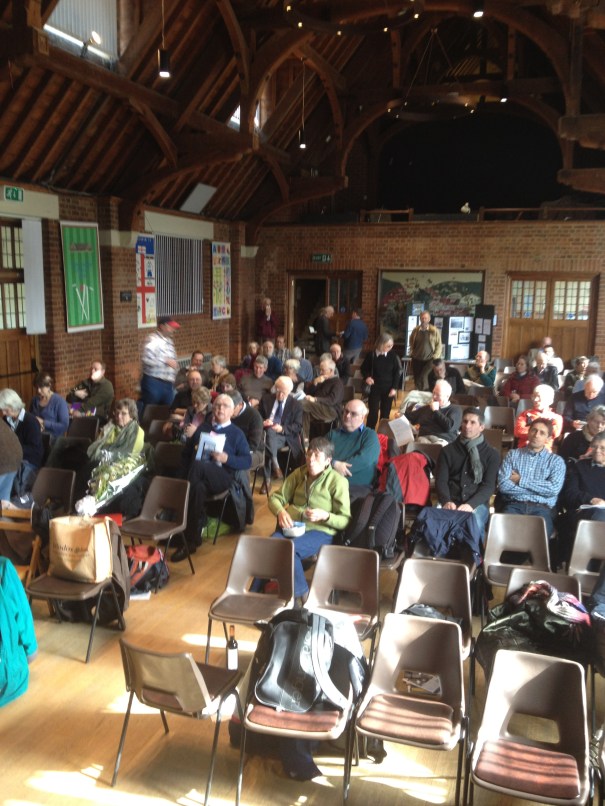
The big day arrived, the last physical conference in May 2019 had 58 wind members attending, this year around 119 took part. So the on-line version allowed more people to participate.

There’s a time saving, and some people could get involved who could never have done so before (like the member dialling in from Tenerife).

Hopefully next year we will have a physical gathering, but I’m sure there will be an on-line element from now on.

Lessons learnt?

  1. Get the right Zoom package – we used the webinar function, which is necessary for more than 100 participants – but which gives you additional control as meeting organisers (its worth it).
  2. Practice – and make sure you are using the Zoom version you will use on the day, the webinar is slightly different from other options. It allows you to have on-line voting (which works well).
  3. Ensure the person chairing is not also managing the zoom meeting, its far too much for one person to handle.
  4. Have a back-up organiser (who may also be sharing their screen with presentations etc) and Chair, connections can and do go down.
  5. Remind people on the day – you will be amazed how many people can’t find their Zoom invitations.
  6. Make sure the people presenting log in with the right authorisation (different from delegate) or they will not be able to take part.
  7. Be super careful using the “chat” function – its very easy to sent a message to every participant when you really only intended to send it to people who are presenting.

Posted in Uncategorized

Focus

I’ve radically simplified my website, too much was about roles from a decade ago.

I’m a portfolio worker. I helped create a credit union, a community owned wind farm, and then a solar farm. That led to a role as a non-exec director in a community renewable energy developer.

I was elected to the board representing community energy projects across Europe, and I’m a director of the community energy association in England.

I joined the board of an inspirational social enterprise that creates low energy work space for social enterprises and finally helped create a transition town charity in my local community.

I’ve started to learn French. That has opened my eyes to a different culture.

In 2010 my career was focussed on finance and local government. Now I use my knowledge to help cooperatives across Europe. I’ve met lovely and inspiring people along the way and I usually leave meetings feeling inspired.

Whilst it was scary at the time – looking back I can see it was the best thing I’ve done.

Posted in Uncategorized

Community energy strategy

Last month’s community energy strategy set out, in part, to identify how to support investment funding for community energy. A series of grants and funding schemes from across different parts of government are highlighted.

Actually there is shortage of investment funding available for renewable energy in the UK. If you are a big six utility company, or high net worth investor with a spare £20 million you can easily invest in a range of renewable energy projects, and benefit from their secure, index-linked returns. But if you only have £500 to spend, your options are more limited.

At the same time, in 2013 – a fairly typical year – Britons collectively invested £1.4bn in equity ISAs. Individuals may get a return, but only once the different intermediaries have deducted their guaranteed fees.

So at both ends, the system is weighted against the smaller investor, though these individuals in their millions, ultimately pay for renewable electricity. It’s no wonder there’s an audience for groups that generate misleading publicity about the cost of green electricity.

Some projects have started to unlock this circle. At Westmill Wind and Solar we developed community energy projects that generated renewable energy and created an investment opportunity for thousands of people. Members get long-term financial returns but can also become involved in the management of their cooperative. Several hundred people attend and vote at AGMs, others help show around the 7,000 (and rising) visitors who have been inspired by touring the site. Many members buy their “own” electricity via the two smaller power suppliers – who have a power purchase agreement with the two cooperatives

The Government’s community energy strategy has many action points. The danger is we lose sight of the interventions that will make the greatest difference. Here are five.

First. Community ownership is quite different from community benefit payments, but the strategy conflates them. Ownership is active and participative, it generates enthusiastic advocates for the projects. Benefit payments are similar to S106 planning payments, they are passive. If big developers can get away with tossing a few thousand into a community fund they will certainly do so, and community ownership will not even get off the starting blocks.

Second. Community projects need not be small, as the strategy appears to envisage. Between them the two Westmill share offers raised over £10m in share capital – and both offers were significantly over-subscribed. Both projects attracted other funding to finance the balance of the project – in the case of Westmill Solar – £12.5m from Lancashire local authority Pension Fund.

More broadly, 5% of the annual ISA equity investments could mean £75m a year invested in community projects. Meanwhile Social Finance Ltd estimated in 2012, if 1% of UK pension funds were invested in community projects – that would represent around £23bn .

Third. Community ownership is popular. A 2012 Cooperative Futures survey showed that fewer than 7% of people would oppose a nearby 100% community-owned wind farm. Yet Westmill wind almost wasn’t built, because of a small minority of people who dominated the planning process. Community projects are uniquely vulnerable to such individuals. In the case of Westmill Wind, the project only succeeded because of the perseverance of local campaigners and subsequently a community developer; Energy4All. Respublica have suggested ways of reforming the planning process so the views of the many are not drowned out by vocal few. These should be pursued.

Fourth. Projects typically need a combination of loan and equity, but bank loans can be hard to find. Pension funds have expressed an interest in this sector but individual projects are not usually large enough to justify due diligence costs. We were told that creating a pipeline of projects is absolutely key to unlocking such investment. The emerging Local Enterprise Partnerships would be well placed to help develop this area.

Finally community energy strategies must be grounded in their communities. Local authorities are best placed to lead and support this change – as the research from Keele University quoted in the strategy already recognises. Indeed many of the successful community ownership structures in Denmark – which the strategy highlights as best practice – have municipal authorities at their heart. Yes too much of the strategy assumed change can only come from Whitehall.

The localism act gives councils enhanced powers to lead in this area. They can identify and bring together landowners, entrepreneurs, national agencies and financiers. Councils can provide the time and encouragement for communities to work up schemes, they can also support them through the planning process, perhaps by offering them first development rights on key sites.

Councils face a delicate balancing act, they must resist the temptation to take over and fund the schemes themselves though prudential borrowing, often under the guise of getting projects off the ground quickly. That would simply replace large commercial developers with a public ones, whilst also adding to public borrowing.

The community energy strategy has come at an important time and should be welcomed. The UK public is cynical, caught between rising costs, fuel poverty (partly because we live in leaky and poorly insulated homes), and an opaque energy generation oligopoly. Community energy can provide much more than a minor contribution, but all sides need to focus on the key changes that will make the greatest difference.

A version of this article previously initially appeared in “Respublica”
Posted in sustainability

Bucks Council talk

I had a really interesting day meeting councillors, managers and local people in Bucks. I was asked to speak about community energy, and whether Buckinghamshire could create the sorts of projects that have started to emerge around Oxfordshire.

My advice was, if councils are serious about creating a real buzz about community energy, the best way of doing this is to create local ownership of those assets. And councils are ideally placed to lead this, helping groups of local people create  such schemes.

A copy of my slideshow is below:

Bucks talk

Posted in Community, sustainability

A collective bond agency

Across Europe local authorities have worked together to create mutual, collective bond agencies. These agencies have meant  councils (not just the large ones) can access bond markets at attractive interest rates.

There are several wider benefits. Individual councils don’t have to pay for individual assessments by rating agencies,  interest rates are attractive and not subject to unexpected change by government fiat.

Our business case demonstrated that a mutual bond agency could be created in the UK, and that by working together councils have the potential for “credit enhancement” – achieving higher credit ratings by working together.

Bonds – do the numbers stack up?

Posted in Finance

Looking outwards

When the going gets difficult organisations tend to look inwards. Over time this can become an ingrained habit, much like a stoop when walking. Looking downwards means you miss what’s going on around you. An inwards focus in an organisation has the same effect.

At Kensington and Chelsea my Director encouraged us to take time out of the office on non-work activities – even at the very busy times. I helped organise and ultimately became vice Chair of CIPFA’s London Division, we organised post qualification training for finance staff across the capital. We all learned from colleagues and from speakers in the events. Those skills served me well when at the LGA I needed to organise professional conferences.

At Oxford I encouraged people to look outwards. We established a graduate training programme and we sent trainees to the CIPFA conference (as day delegates), we bought and circulated the relevant professional magazines (they had been cancelled as a previous cost cutting measure). We established a programme of lunchtime seminars for managers across the authority where we heard from external speakers.

I noticed a difference, people started to take new ideas an apply them. Our performance management thinking came from one of our staff who had studied those concepts as part of her wider professional studies.

The danger with the current austerity is we cut those opportunities. We save pennies but waste pounds. A self confident local government needs to look outwards, learning from the best practice – wherever it is.

Posted in Efficiency

From efficiency to effectiveness

I have worked at different authorities, some seen as the best in the country and others viewed as “failing”. These measures were far from perfect, failing sometimes meant failing to follow the maxim of the government of the day.

Nearly all of the staff in the failing authorities were every bit as good as those in the excellent ones. But I saw three key differences:

Firstly, the excellent authorities identified and then focussed on priorities – the staff actually worked fewer hours. In failing organisations everything is a priority and people rush from one task to another. Long working days are common.

Second – there was an emphasis on basic management at all levels. This included delegating and succession planning, helping individuals learn and develop, challenging priorities and looking at blockages and timetables. In weaker authorities managers were able to get away with the excuse they were “too busy to manage”.

Finally – investment in systems, both IT and other. When I first arrived at Oxford I found staff who were hampered by systems that didn’t work properly. I still see front-line staff in different organisations trying to deliver a good service whilst juggling faulty bits of equipment.

The key is the difference between efficiency (doing things well) and effectiveness (doing the right things).

One of the books that really impressed me is by Richard Koch (link via Amazon below). He argues about 20% of work undertaken within organisations is of real importance, the rest is largely wasted effort. I can see that in some of the tasks I’ve been asked to take on over the years. Reports read once and then discarded, initiatives that were seen as important but which duplicated other work, long management meetings when decisions had already been taken… and so on.

Effective people and organisations are ones who focus on what they are good at, and know what is really a priority. The key is to really think hard about what will make a difference in two/five/ten years time.

Posted in Efficiency

Benchmarking

There’s a renewed interest in benchmarking, it can be a helpful tool.

When I worked at the Audit Commissioner Local Government they used to produce an annual statement analysing each council’s costs. You could see if a high cost service resulted from a service which had greater volumes, or higher costs per transaction.

By way of a fictitious example –  you might look at a library service. You could see the staff costs – and that they were above average, but then by looking at the pay per employee (compared with the average) and number of staff employed/book stock you might find it was because whilst individual pay was below average, but that the library employed more staff than typical. You might then find that the library was much better used than neighbouring libraries.

The first lesson we learned at the Commission was that the information was merely a prompt to ask questions, it was not an answer in itself.

At Oxford City Council I developed our own set of variance analyses. We used some of the same cost trees that the Commission had a decade before. We included that in our annual performance report. Managers across the council contributed with varying degrees of enthusiasm.

The analysis and the subsequent assessment by the scrutiny panel helped that council understand why some costs were comparably high – and helped start a discussion about service levels.

What did I learn?

Benchmarking helps managers ask sensible questions based on a shared understanding. The benchmarking should be sufficient to achieve this, but no more. Its very easy to devote ever more resources into this area for sharply declining returns.

A benchmarking study can create stiff resistance. This will involve questioning the analysis as insufficiently detailed/missing key points and so on. Partly this may be true, but the danger is to over complicate the work. Less is better.

Finally avoid the siren voices trying to find the “most relevant” comparator. If you can – try to benchmark against different businesses, and certainly the best one organisations can find. If you can – look across different sectors and countries.

Posted in Efficiency, Finance